Your cart is empty
Tax included and shipping calculated at checkout
Tax included and shipping calculated at checkout
Drawer menu
In brief
- How to set a table on a yacht starts with the rules ashore. Debrett's puts knives and spoons on the right and forks on the left, used from the outside in.
- Service names clash: serving each guest from a platter is "silver service" to the crew-training site YPI Crew and "Russian service" in a US catering lesson.
- None of the sources checked describes how superyacht crew lay a table under way. On sailing yachts, Germany's YACHT magazine suggests a rubber mat or "a damp tea towel underneath" the crockery.
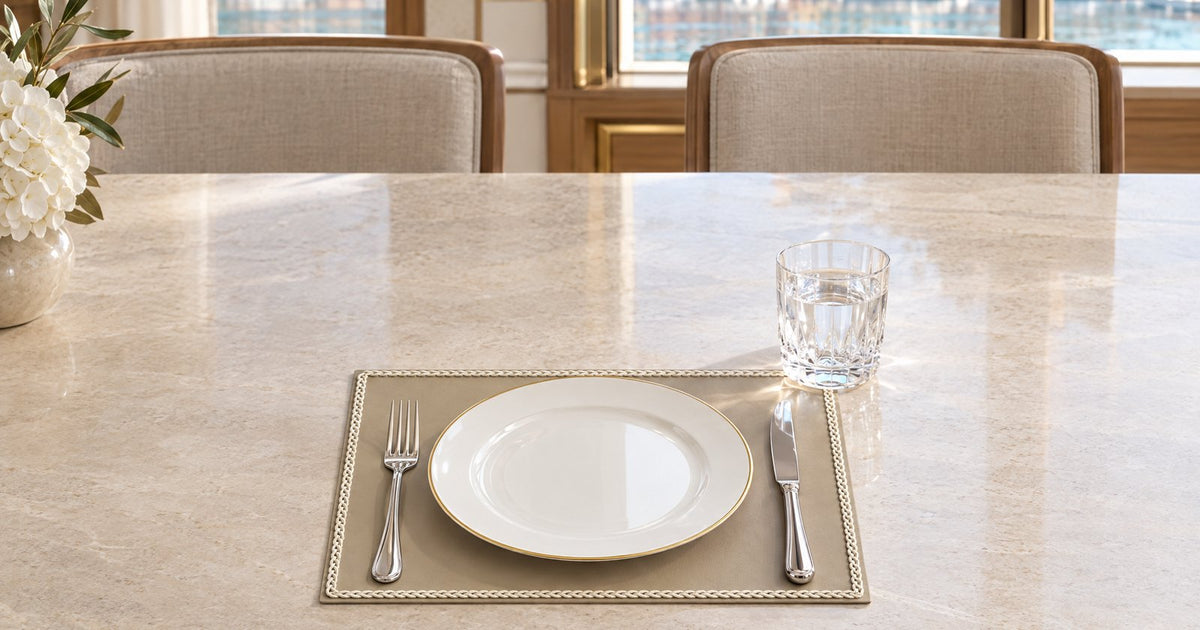
- A Veyra Deck faux leather placemat marks the cover and protects the table; it is not a non-slip mat.
- For covers at anchor and on deck, Veyra Deck suggests a faux leather placemat at each place and napkins in rings, from the tabletop collection.
Lunch is laid on the aft deck at anchor. The plates and glasses are down, the platters are still in the galley, and the breeze reaches the napkins first.
Setting a table on a yacht means laying each cover by the rules used ashore and serving in the style the owner or guests prefer. Both then change for a deck that moves and catches wind. The rules ashore are well documented; the changes at sea mostly are not, so the sections below mark where the sources stop and Veyra Deck's suggestions begin.
The cover is each guest's place setting: "the plate, silverware, glasses, and napkin to be used by each person", in the words of a US catering lesson. A yacht table setting starts from the same rules as one ashore. Debrett's puts forks on the left, knives and spoons on the right, and glasses above the knives.
Debrett's adds that it is "correct always to lay side plates", even unused ones, because they give "sufficient elbow room". Napkins "should be simply folded or rolled and placed on the side plates". Cutlery is worked "from the outside in", and the space between places is even, ideally at least 51 cm (20 in).
The US lesson, hosted by the Illinois State Board of Education, measures the cover itself rather than the gap between places. It gives each cover about 64 cm: "Approximately 25 inches of space is needed for each cover." Cutlery sits about 2.5 cm in, "1 inch from the edge of the table and in the order of use". The two measures differ, and the metric figures are conversions.
Dessert cutlery is where the sources part. For formal dinners, Debrett's says "pudding spoons and forks should be laid innermost and not above the place setting", or brought in if space is short. The Illinois lesson puts the dessert spoon and fork "directly above the dinner plate" in a French-service cover. At a banquet, it says, a dessert fork "may be placed above the dinner plate".
For wine, Debrett's table-manners guide says "the bigger, rounder wine glasses are for red, and the taller, thinner ones are for white".
The diagram below sets a formal dinner cover beside a simpler cover for lunch on deck or under way; the simpler cover is Veyra Deck's suggestion.

See the faux leather placemats in the tabletop collection.
Service styles on a yacht differ by what the crew does with the food. The chef may plate it in the galley, or a stew may serve it from a platter, present the platter, or leave it on the table. The names change between yacht crew training and US catering education, so the table sorts the styles by action.
Service styles on a yacht, by what the crew does
The "What happens" and "Served from" columns follow YPI Crew, a yacht crew recruitment and training site, unless another source is named.
| Style | What happens | Served from | Also called (source) | Use and setting (source) |
|---|---|---|---|---|
| Silver service | The chef plates food onto platters; a stew serves each guest with a spoon and fork | The left, "generally"; "always from the left" (Wikipedia) | English service (Wikipedia); "Russian service" (Illinois lesson) | "regarded as formal service" (INFLIBNET, a hotel-catering course, ashore); the practical on one stew course (Crew Pacific) |
| Butler service | A stew presents the platter; the guest serves themselves with a spoon and fork | The left | French service (YPI Crew; Illinois lesson); "family service" (INFLIBNET) | "isn't as commonly used as the other Service styles" (YPI Crew) |
| Russian service (YPI Crew's version) | Served as in silver service, then the platters are "placed in the middle of the table" | The left, "generally" | "Russian/ Family Style Service" (Maritime Professional Training) | Crew service training (YPI Crew; Maritime Professional Training) |
| Plated (American) service | The chef plates in the galley; a stew sets each plate in front of the guest | The right, "generally" | American service (YPI Crew); "plated service" (INFLIBNET) | "a simple and informal style of service" (INFLIBNET, ashore) |
| Family style | A stew sets platters and bowls in the middle of the table; guests help themselves | No server at the plate | Family-style table service (Illinois lesson) | An "informal" setting (Illinois lesson, ashore) |
| Buffet | Platters go on a side station; guests serve themselves | No server at the plate | None given | Fewer servers: "The number of servers needed is reduced" (Illinois lesson, ashore) |
| Synchronised service | All plates "placed down on the table at the same time" | Not stated | None given | Listed as "Synchronized Service" on a PYA GUEST course (Maritime Professional Training) |
The labels do not travel well. To YPI Crew, Russian service is silver service with the platters left on the table; the Illinois lesson uses the name for silver service itself. French service means butler service in both. INFLIBNET's course, an Indian university hospitality module, also calls it "family service". Crew Pacific files French and Russian under silver service.
The term also names a standard. An Australian Government training unit defines "silver service standard" as "superior table service in a fine-dining setting". Every style in the table except buffet appears, family style paired with Russian, on the topic list of a PYA GUEST course in Fort Lauderdale.
The owners' preference sets the style aboard. YPI Crew says each yacht has "a bespoke style of Service based on the owners' preference", which the head of department knows from working with them. On charter, the chef relies on guests' preference sheets "to create the menus", says Boat International. The same 2015 guide says "every charter yacht is fully prepared to provide you with formal dining every night".
For the preference sheet and the rest of life aboard, read the crewed yacht charter etiquette guide.
Boat International reported in June 2025 that some superyacht owners are saying no to silver service. It quoted one owner: "I prefer family-style (service) and shorter meals." Active charter guests, it added, "tend to prefer buffet-style service, particularly for breakfast and lunch". That is one report; read it beside the 2015 guide above, which describes formal dining as available every night.
On one yacht of about 50 m, one stewardess's published diary on Superyacht Content says lunch "is usually served family style and can be more casual".
The Illinois lesson, written for service ashore, sets a different cover for each style:
None of the sources checked for this guide sets out how superyacht crew lay a table under way. What is documented is older, smaller in scale or about stowage. Fiddles guard tables in rough weather, the sailing press recommends bowls and damp tea towels, and glassware is strapped down for ocean crossings.
A fiddle, in the American Heritage Dictionary's definition via Wordnik, is "A guardrail used on a table during rough weather to prevent things from slipping off." Dickens' weekly Household Words described fiddles in 1858–59 as "square mahogany frames, put on the table to keep the plates in place in rough weather". When the steward put them on at meal-times, the writer knew "the wind was rising, and that there would not be many at dinner".
On sailing yachts, the advice is about bowls and a free hand. Germany's YACHT magazine recommends "a bowl or a deep plate with a raised freeboard", food eaten with one utensil, and "one hand free for the plate". It suggests crockery "with a non-slip rubber base"; without a suitable rubber mat, the fallback is "a damp tea towel underneath".
Ships improvised too. A Port Huron Museums audio tour of the Huron lightship describes crew putting a wet rag on "the slippery, stainless tabletop" under each plate. The officers' table had a "fiddleboard". For ocean crossings, a Dockwalk chief stew's guide says glassware and crockery "need to be safely secured", which is stowage for the passage, not guest service.
On a motor yacht under way, Veyra Deck suggests laying fewer pieces and using tumblers rather than stemmed glasses. It also suggests rolling napkins into rings, laying a non-slip mat under any tablecloth and moving dinner inside if the motion grows. None of this is a published crew standard.
A faux leather placemat does a different job: it marks the cover and protects the table from heat and scratches. The Round Faux Leather Placemat – 36 cm, from $130, is 1 cm thick. Its product page says it "does not curl at the edges as thinner materials do", which keeps a cover tidy. The faux leather placemat is not a non-slip mat; to stop crockery sliding, the sailing press puts a rubber mat or a damp tea towel underneath.
At anchor, under way, on a crossing
| Situation | What sources describe | Veyra Deck's suggestion |
|---|---|---|
| At anchor in swell or wind | In heavy swell or wind, "it might not be suitable to seat guests outside"; "Discuss with the deck crew" (one stewardess's diary) | Ask the deck crew before laying outside; keep an inside table ready |
| Under way on a sailing yacht | Bowls or deep plates, one hand free, a rubber base or a damp tea towel under crockery (YACHT; Blue Water Sailing) | Lay cutlery for one course at a time |
| Under way on a motor yacht | No published crew standard found | Fewer pieces, tumblers, napkins in rings, a non-slip mat under any cloth |
| On an ocean crossing | Glassware and crockery secured for the passage; guest service not covered (Dockwalk) | Lay only what each meal needs and stow the rest |
For the aft deck, sundeck and salon, read the guide to rooms on a yacht.
Wind on deck shows up in the crew press. A Dockwalk stew-training scenario puts dinner on the aft deck "despite whipping winds". A Dockwalk chief stew swaps candles for battery lights when the wind is too strong. Ashore, Debrett's keeps flowers "low enough for guests to see over". For napkins, Veyra Deck suggests rings or a holder, not loose folds.
In that 2010 scenario a gust knocks a bowl from the stew's hand. The expert's line is plain: "While guests are dining, crew are serving and the boat is moving, there is always the possibility of a spill."
On deck, Veyra Deck's napkin suggestion means each napkin rolled into a ring, or the stack kept in a napkin holder with a handle across it. The Stainless Steel Napkin Ring with Leather Wrap, from $120, holds a dinner napkin rolled or folded. It is 316 stainless steel with polished rims and a leather braid worked by hand around the steel core. It comes in eight colourways and is sold singly.
For a deck buffet or a casual lunch, the woven-embossed leather napkin holder, from $210, holds a full stack of dinner napkins. It measures 21 × 21.5 × 3.5 cm, and the weave texture is pressed into the leather. Its polished 316 stainless steel handle runs across the top of the holder. It comes in seven colourways.
Wipe the leather on both with a soft, slightly damp cloth and dry the steel afterwards. The care and maintenance page sets out the full routine; for life aboard, read leather care on a yacht.
Choosing placemats or a tablecloth on a yacht comes down to the hour and the lockers. A chief stewardess quoted by one brokerage describes placemats and brighter napkins by day and a more formal setting at dinner. Storage shapes the choice too, and a US catering lesson treats a tablecloth as typical at a banquet.
A chief stewardess quoted by the brokerage Burgess says that by day her crew "use brighter coloured napkins and placemats". For dinner, the same piece describes "a more formal, sophisticated setting", with silk napkins. Chief stew Bugsy Drake, in Dockwalk, notes that "due to limited storage, you can get two colors out of one place mat". The Illinois lesson says of the banquet table: "A tablecloth is typically used."
Where mats are used, Debrett's sets each one about 2.5 cm (1 in) from the table's edge, "at the centre of each place setting".
Veyra Deck faux leather placemats
| Placemat | Size | Colourways | From | Where it fits (Veyra Deck's suggestion) |
|---|---|---|---|---|
| Round Faux Leather Placemat – 36 cm | Ø 36 cm × 1 cm | 10 | $130 | Round tables and formal covers; the product page says the circle "frames a plate cleanly" |
| Rectangular Faux Leather Placemat – Large, 50 × 35 cm | 50 × 35 × 1 cm | 7 | $90 | A long table and a full cover; the product page lists "plate, cutlery either side, and a glass above" |
| Braided-Edge Rectangular Placemat – 40 × 30 cm, faux leather | 40 × 30 cm | 5 | $80 | Daily service and deck lunches; the product page says it "wipes clean easily" |
By arithmetic, not by any standard, the 50 cm faux leather placemat sits inside a 64 cm (25 in) cover with about 7 cm spare each side. All three are made by hand in Türkiye.
For matching sets, the 50 × 35 cm faux leather placemat and the napkin holder share seven colourway names: Khaki, Black, Navy Blue, Grey, Mink, Beige and Tan. The napkin ring comes in those seven plus Brown.

For the rest of the galley and dining kit, read the room-by-room guide to yacht accessories.
Table design will be judged at the Antigua Charter Yacht Show, which will run 4–9 December 2026 at Nelson's Dockyard. Its "Concours de Chef & Yacht Table Design and Service Competitions" sets the table theme "The Compass Setting". Yachts enter in one of three size bands, and each band is judged on its own day.
The rules say the table "should be in the same location where the chefs serve their creations and include place settings for 6 guests". The five judges and the coordinator will sit and dine at it. Tables will be scored on Appearance & Presentation, Creativity & Originality, Service & Atmosphere, and Overall Impression.
The Concours will judge one size band a day, per the competition rules, with metric lengths approximate:
Awards will be presented on 8 December, per the event schedule. The rules cap entries at "10 yachts in each yacht size category".
The 2025 theme was "A Journey of Wellness", per the show's report and Dockwalk. The 2026 MYBA Charter Show in Sanremo set the theme "A Flower Feast for Breakfast", per Dockwalk. Its report says "the chief stews went to town on the tablescaping".
For the season's other shows, see the superyacht season calendar 2026–2027.
A pre-service checklist for a yacht table runs from the service style to the centrepiece. Items with a link are sourced; the rest are Veyra Deck's advice for chief stews and interior crew, not an industry standard. Work through it before guests are called to the table, at anchor or under way.
For daily service and deck lunches, see the Braided-Edge Rectangular Placemat, a faux leather placemat that wipes clean.
The six questions below cover silver and butler service, family style and plated service, how far cutlery sits from the table edge, sliding plates and fiddles. Each answer stands alone, links to its source and marks Veyra Deck's own advice where it appears.
Silver service is a formal style in which a stew serves each guest from a platter with a spoon and fork. YPI Crew, a yacht crew training site, says it is served generally from the left. A US catering lesson hosted by the Illinois State Board of Education calls the same act "Russian service", so check which names a crew uses.
In silver service the stew serves the food onto each guest's plate; in butler service the stew presents the platter and the guest serves themselves. YPI Crew has both offered from the left with a spoon and fork. Butler service is also called French service, and YPI Crew says it "isn't as commonly used as the other Service styles".
Yachts use both family style service and plated service; the owners' preference decides. YPI Crew says each yacht has "a bespoke style of Service based on the owners' preference". On one yacht of about 50 m, one stewardess's published diary says lunch is usually served family style. Boat International quoted an owner in 2025 who prefers "family-style (service) and shorter meals"; that is one report, not a survey.
About 2.5 cm (1 in). A US catering lesson hosted by the Illinois State Board of Education says silverware "should be placed 1 inch from the edge of the table". It gives each cover about 64 cm (25 in). Debrett's sets a table mat "about an inch from the table's edge", with ideally at least 51 cm (20 in) between places. The metric figures are conversions.
On sailing yachts, Germany's YACHT magazine suggests bowls or deep plates with a raised rim and crockery with a non-slip rubber base. Without a suitable rubber mat, it suggests a damp tea towel underneath. Fiddles, guardrails used on a table in rough weather, are there to stop things slipping off. No published superyacht standard was found, and a Veyra Deck faux leather placemat is not a non-slip mat.
Fiddles are rails or frames fitted to a table on a boat to keep things in place in rough weather. The American Heritage Dictionary, via Wordnik, defines a fiddle as "A guardrail used on a table during rough weather to prevent things from slipping off." In 1858–59, Household Words described fiddles as "square mahogany frames, put on the table to keep the plates in place in rough weather".
Veyra Deck's advice is to start with a faux leather placemat at each place and a napkin ring for each guest. Add a napkin holder for buffet lunches on deck. Each piece below is from the tabletop collection, and the placemat, ring and holder share seven colourway names.
For drinks on deck, read the yacht bar accessories buying guide.
Every piece is finished and packed by hand before it leaves Türkiye. Orders are dispatched within 3-7 business days and typically arrive 6-10 business days after dispatch, about 2-4 weeks in all. Shipping is free worldwide and duties are paid.
Orders ship Delivered Duty Paid (DDP): we pay customs duties and import taxes, so the checkout price is the total. Nothing is charged on delivery.
Returns are accepted within 30 days of delivery with a prepaid return label; bespoke pieces are excluded. See the refund policy.
Bespoke sizes and finishes are available for yacht and contract projects: info@veyradeck.com. For outfitting several yachts or a fleet, see wholesale.
Sources
Sources checked 25 October 2026. Sourcing follows our editorial standards.
 Round Rope Serving Tray: Which Size Carries What
November 2026Choosing a round rope serving tray: 13.8 in or 17.7 in, how many glasses fit on each, how to carry a full tray, and care for the glass an...
 How to Serve Raki (Rakı): Water, Ice and the Meze Table
November 2026How to serve raki the Turkish way: chilled water, ice if wanted, tall glasses and meze, plus the law behind raki's 40% minimum alcohol st...
 How to Chill Champagne in an Ice Bucket, Indoors and on Deck
November 2026How to chill Champagne in an ice bucket: half ice, half water, 20–40 minutes from a cool bottle to 46–50°F (8–10°C), and how to keep it c...