Your cart is empty
Tax included and shipping calculated at checkout
Tax included and shipping calculated at checkout

Drawer menu
In brief
- A leather backgammon set aboard has two jobs: open wide enough to play at anchor, then fold small enough for a locker before the yacht moves.
- Each player starts with 15 checkers: two on the 24-point, five on the 13-point, three on the 8-point and five on the 6-point (US Backgammon Federation).
- Under the federation's tournament rules, dice in a cup are shaken at least twice, then rolled in one action on the right-hand side of the bar.
- A lone checker 6 points from an opposing checker is hit by 17 of 36 rolls; at 7 points, by 6 of 36 (bkgm.com, a community reference). Both figures assume no blocking points between.
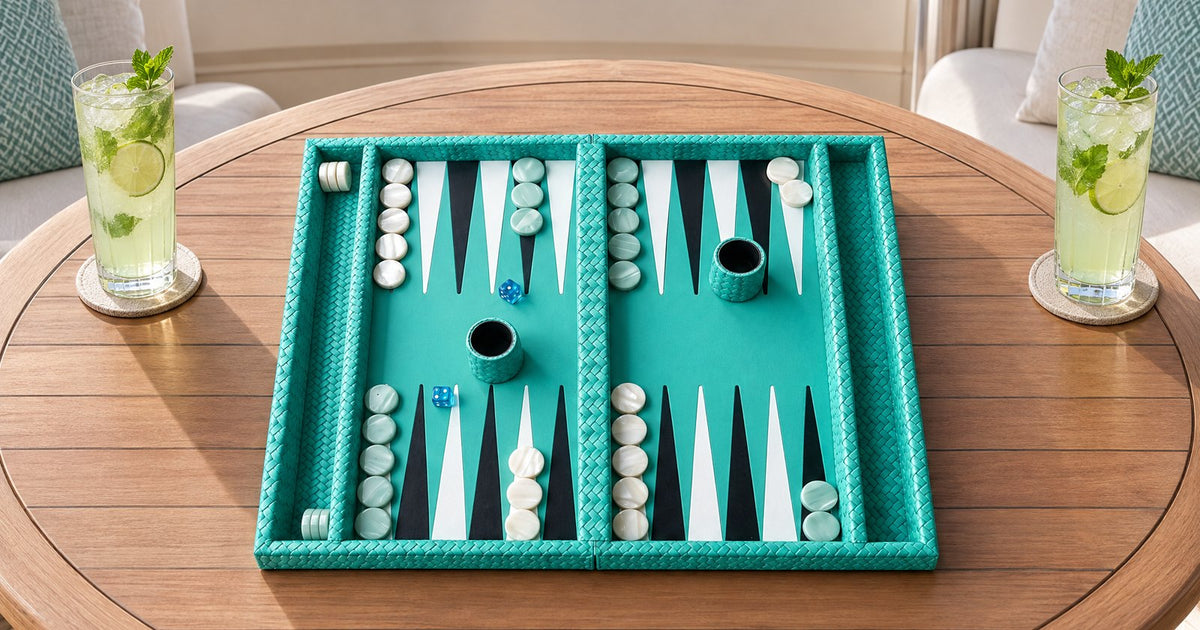
- Start with the folding leather backgammon set, from $790, in Turquoise, Cream, Forest Green or Sage Green.
Mid-afternoon at anchor, lunch is cleared from the flybridge table. A folding board opens between two glasses, and the checkers go down in their starting stacks.
Backgammon is a game for two players, played on a board of 24 narrow triangles called points, according to the US Backgammon Federation (USBGF). Each player has 15 checkers of their own colour, a pair of dice and a dice cup for shaking.
For the rest of the boat, see the room-by-room guide to luxury yacht accessories.
The origin of backgammon is still poorly understood, but Encyclopaedia Iranica says Persia clearly played an important role in its early development. The modern board of 24 points came into being under the Roman Empire, the Suda On Line notes. In Türkiye the game is tavla, from the Italian tavola, the Turkish Language Association (TDK) records.
Persian tradition places the invention of backgammon, under its Persian name nard, only in the third or even sixth century CE, Iranica notes. The Middle Persian text The Explanation of Chess and the Invention of Backgammon is dated to the reign of Xusrō I, writes Iain Gardner.
In the Roman Empire, the 24-point game was called alea in Rome and tabla in Greece, according to the Suda On Line. The same entry calls it the ancestor of modern tavli in Greece and of backgammon.
The earliest evidence for the English word backgammon in the Oxford English Dictionary is from 1647, in the writing of historian James Howell. The dictionary says backgammon is "apparently formed within English, by compounding".
The TDK dictionary defines tavla as a game two people play facing each other, on a two-sided board divided into sections, with thirty pieces and two dice. Tavla "can easily be considered Turkey's national game", in the view of the newspaper Daily Sabah in 2014.
Writing on Ottoman coffee houses, Hürriyet Daily News quotes the seventeenth-century chronicler Peçevi: "some were busy with backgammon and chess". In February 2026, Daily Sabah wrote that Istanbul's coffee houses "are marked by the rhythmic clicking of backgammon tiles".
A backgammon board has 24 narrow triangles called points, which alternate in colour and sit in four quadrants of six, the USBGF explains. The quadrants are each player's home board and outer board. A ridge down the centre, called the bar, separates the home boards from the outer boards.

| Part | What it is | Role in play |
|---|---|---|
| Points | 24 narrow triangles, alternating in colour | Checkers move forward to lower-numbered points |
| Home and outer boards | The four quadrants of six points, two per player | Each player's numbering starts in their home board |
| Bar | The ridge down the centre | Hit checkers wait here to re-enter |
| 24-point | A player's outermost point, the opponent's 1-point | Two checkers start here |
| Bearing off | Moving checkers off the board | Allowed once all 15 checkers are home |
Source: USBGF, Backgammon Basics.
Setting up a backgammon board takes 15 checkers a side on four points, the USBGF sets out. Each player puts two on their 24-point, five on their 13-point, three on their 8-point and five on their 6-point. Points are numbered separately for each player, starting in that player's home board.
Backgammon rules rest on four actions: moving checkers forward by the numbers rolled, hitting single checkers, entering from the bar and bearing off. The first player to bear off all their checkers wins the game, according to the US Backgammon Federation. Its Backgammon Basics page is the source for every rule in this section.
Checkers always move forward, to a lower-numbered point, and may land only on an open point: one not occupied by two or more opposing checkers. A player must use both numbers of a roll if legally possible. Doubles are played twice, so a roll of 6 and 6 gives four sixes to use.
A point occupied by a single checker of either colour is called a blot. If an opposing checker lands on it, the blot is hit and placed on the bar. A player with a checker on the bar must enter it first, into the opposing home board. It enters on an open point matching one of the numbers rolled.
Once a player has all 15 checkers in their home board, they may start bearing off. A checker is borne off by rolling the number of the point it sits on. A loser who has borne off no checkers is gammoned and loses twice the value of the doubling cube. If that loser also has a checker on the bar or in the winner's home board, they are backgammoned and lose three times the value.
The doubling cube, with 2, 4, 8, 16, 32 and 64 on its faces, keeps track of the current stake. A player may offer a double only at the start of their own turn, before rolling. A player who accepts becomes the cube's owner, and only they may make the next double.
The backgammon odds worth knowing are the chances of hitting a blot. With no blocking points between, a blot 1 to 6 points from an opposing checker is hit by 11 to 17 of 36 rolls. From 7 points away, it falls to 6 of 36 or fewer, in Jacoby and Crawford's table on bkgm.com, a community reference.
| Distance (points) | Hitting rolls (n/36) | Chance (%) |
|---|---|---|
| 1 | 11/36 | 31 |
| 2 | 12/36 | 33 |
| 3 | 14/36 | 39 |
| 4 | 15/36 | 42 |
| 5 | 15/36 | 42 |
| 6 | 17/36 | 47 |
| 7 | 6/36 | 17 |
| 8 | 6/36 | 17 |
| 9 | 5/36 | 14 |
| 10 | 3/36 | 8 |
| 11 | 2/36 | 6 |
| 12 | 3/36 | 8 |
The table assumes no blocking points between the two checkers. Counts are from Jacoby and Crawford, confirmed by Sho Sengoku's tables; percentages are rounded.
The practical rule: a blot 7 or more points from an opposing checker is much safer than one within 6. The chance of a hit falls from 47% at 6 points to 17% at 7. Beyond 6 points no single die reaches, so only combinations of both dice can hit.
A good backgammon set gives each player 15 checkers, a pair of dice and a dice cup, the equipment the USBGF describes. Beyond that, size, dice cups and a case that closes decide how well a set plays and travels. Tournament rules add detail on checker size and rolling.

Check these before buying:
A cup turns each roll into a set routine. Under the same tournament rules, dice in a cup are shaken vigorously, at least twice up and down. They are then rolled in one action on the right-hand side of the bar, with enough force and height to tumble freely. A baffle box is the permitted alternative.
For a board that folds for a locker, see the four colourways of the folding leather backgammon set.
Playing backgammon on a yacht comes down to three choices. Set the board in shade and out of the wind, roll from cups, and fold the board away before the yacht moves. On an Atlantic crossing, yacht owner Ilia Rigas found time to "read a book, play backgammon", Boat International reported.
In the salon, set the board on the dining or coffee table. The cockpit and flybridge move the game outside, part of the shift towards open-air living on superyacht decks. Outside, pick a shaded table.
Aboard, a table can move, so it helps to know both versions of the dice rule. Under the USBGF beginner rule, the dice "must be rolled together and land flat" on the player's right-hand section of the board (USBGF beginner's guide). If a die lands outside that section or does not land flat (a "cocked" die), both dice are re-rolled.
A 2023 USBGF rule FAQ notes that the word "flat" "does not appear anywhere in the current rule". The tournament rules effective January 2025 treat a roll as invalid if a die is "balanced on edge or corner" or "supported by a vertical surface". The FAQ advises calling "invalid" or "cocked" at once, "to avoid any dispute in case the die later tips over".
A backgammon set for a yacht is stowed between games, so its folded size matters. Close the folding backgammon board and stow it before the yacht gets under way, as the yacht guest cabin checklist advises for loose items.
Veyra Deck's folding leather backgammon set, from $790, opens to 50 x 38 x 3 cm (19.7 x 15 x 1.2 in). It folds closed to carry and stows folded in a locker. Made by hand in Türkiye, it comes in four colourways, each with two leather-covered dice cups.

Open, it is a full playing size rather than a travel compromise. Folded, it measures 38 x 25 x 6 cm (15 x 9.8 x 2.4 in): check it against the locker. It suits the salon, cockpit and cabins aboard.
| Colourway | Field (as photographed) | Points | Checkers (as photographed) |
|---|---|---|---|
| Turquoise | Turquoise | Black and white | Turquoise and ivory |
| Cream | Cream | Navy and cream | Ivory and dark brown |
| Forest Green | Ivory | Green and beige | Ivory and dark brown |
| Sage Green | Ivory | Navy and sage | Grey and ivory |
Players who need tournament-size checkers should ask about checker diameter before ordering: info@veyradeck.com.
Looking after a leather backgammon board aboard is simple. Wipe it with a soft cloth, keep it from standing water and long spells of direct sun, and stow it folded and dry. Veyra Deck's care and maintenance page sets out the routine, and the guide to leather care on a yacht covers salt air, sun and humidity.
Keep drinks on coasters beside the board, and bring the board in after a game on deck.
A backgammon set makes a practical gift for a yacht: two people can play at anchor, and a folding set stows between games. The folding leather backgammon set sits in Veyra Deck's gifting collection, and its four colourways let a buyer match the board to the boat.
For more ideas, see gifts for yacht owners at the 2026 Fort Lauderdale boat show.
Short answers first: a board is set up from four starting points a side, and boards vary in size. Tournament players use a dice cup or a baffle box. Backgammon mixes luck and skill, tavla is its Turkish name, and a folding board stows between games aboard. Details and sources follow.
In backgammon, each player sets out 15 checkers on four points of their own numbering (USBGF). Two go on the 24-point, five on the 13-point, three on the 8-point and five on the 6-point. Each player then throws one die to decide who starts.
Backgammon boards vary in size, and the US Backgammon Federation's tournament rules give no standard board size. Veyra Deck's folding leather backgammon set, for example, opens to 50 x 38 x 3 cm (19.7 x 15 x 1.2 in). Folded, it measures 38 x 25 x 6 cm (15 x 9.8 x 2.4 in).
For tournament play, yes, or a baffle box: the US Backgammon Federation's in-person tournament rules let each player choose either. Under those rules, dice in a cup are shaken at least twice, then rolled in one action on the right-hand side of the bar. The federation's Backgammon Basics page also gives each player their own pair of dice and a dice cup used for shaking.
Backgammon mixes luck and skill, on the evidence of its rules and odds. No player chooses the roll, but players choose which checkers to move and whether to offer a double (USBGF). Those choices change risk. With no blocking points between, a lone checker 6 points from an opposing checker is hit by 17 of 36 rolls. At 7 points, 6 of 36 hit (bkgm.com, a community reference).
Tavla is the Turkish name for backgammon. The Turkish Language Association dictionary traces the word to the Italian tavola. It defines tavla as a two-player game with thirty pieces and two dice on a two-sided board divided into sections. The newspaper Daily Sabah wrote in 2014 that tavla "can easily be considered Turkey's national game".
Yes: a game needs two players, a set and a table, and a folding board stows between games. Roll onto the right-hand side of the bar, as the US Backgammon Federation's tournament rules require, and call a cocked die at once, as its rule FAQ advises. Yachting reported that the crew of the motor yacht Camille set up backgammon in case guests wanted to play but hesitated to ask.
Start with the Veyra Deck folding leather backgammon set, from $790, in Turquoise, Cream, Forest Green or Sage Green. Add the Woven Leather Coaster Set with Stainless Steel Stand, from $180, for drinks beside the board. The Large Woven Leather Serving Tray with Stainless Steel Handles, from $490, carries the drinks out. Then see the gifting collection.
Pieces are held in stock and ship from Türkiye within 1-2 business days. Delivery typically takes 4-15 business days depending on the destination. Shipping is free worldwide. Orders ship Delivered Duty Paid (DDP): we pay customs duties and import taxes, so the checkout price is the total. Nothing is charged on delivery.
Bespoke sizes and finishes are available for yacht and contract projects: info@veyradeck.com. For trade orders, see wholesale.
Sources
Sources checked 30 September 2026. Sourcing follows our editorial standards.
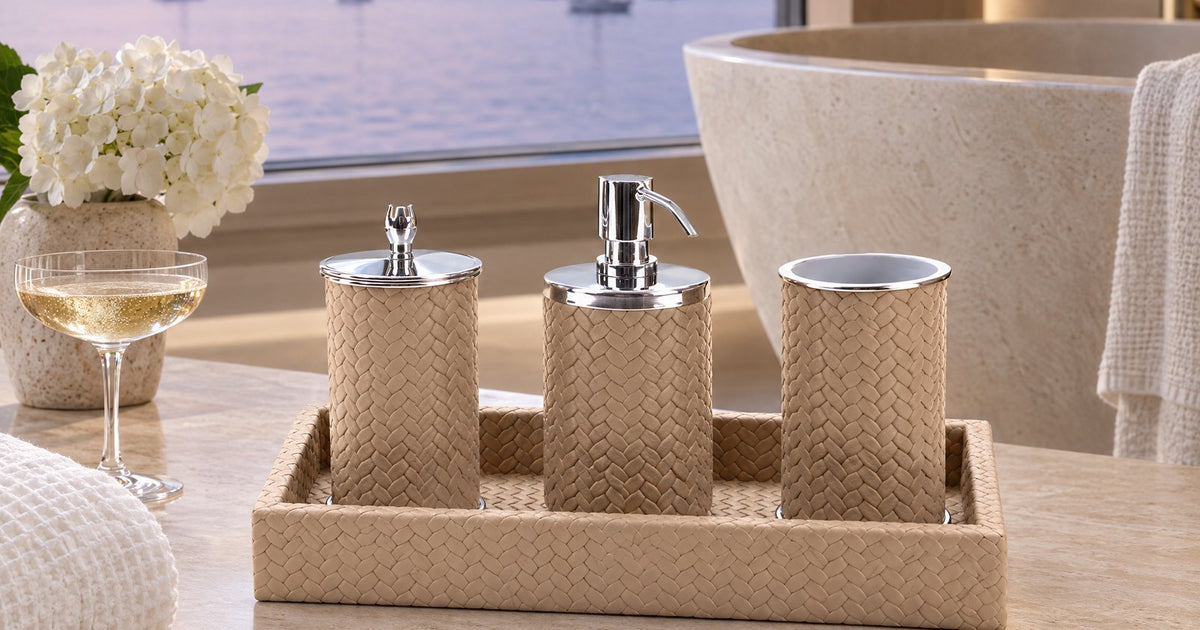 Yacht Guest Cabin Checklist: Prepare, Service and Stow
September 2026Yacht guest cabin checklist for crew and owners: the walk-through, bedside, heads, preference sheet, turndown and stowing before the yach...
Yacht Guest Cabin Checklist: Prepare, Service and Stow
September 2026Yacht guest cabin checklist for crew and owners: the walk-through, bedside, heads, preference sheet, turndown and stowing before the yach...
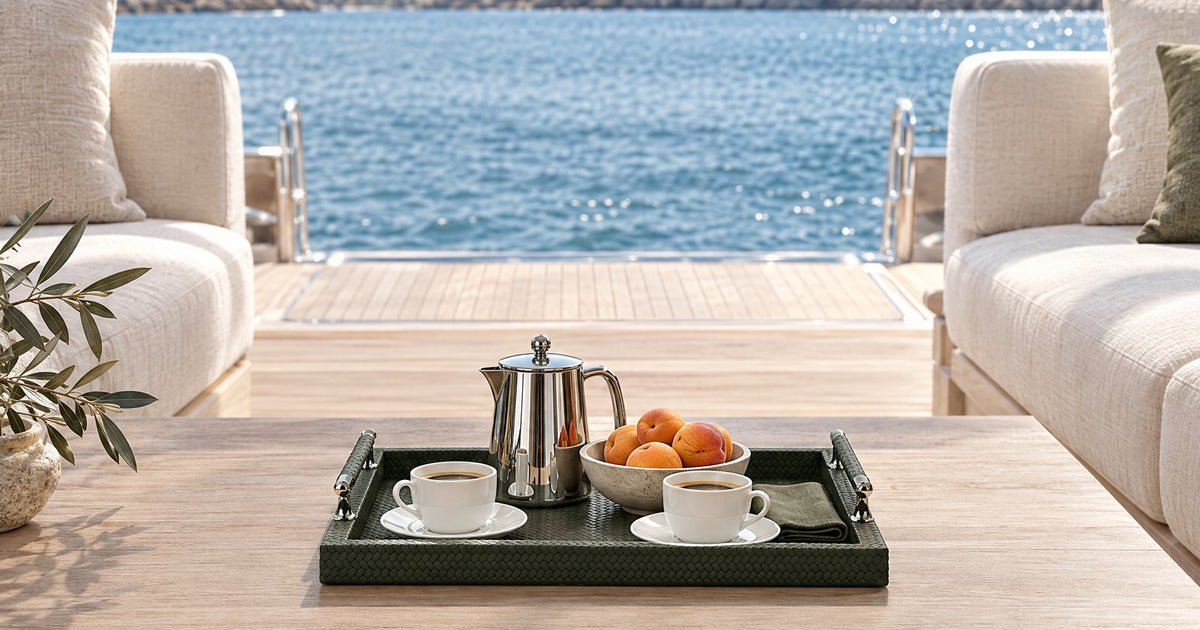 Leather Care on a Yacht: Salt Air, Sun and Humidity
September 2026Leather care on a yacht, from conservation guidance: salt tide lines, mould above 65% relative humidity, sun, condensation and why dressi...
Leather Care on a Yacht: Salt Air, Sun and Humidity
September 2026Leather care on a yacht, from conservation guidance: salt tide lines, mould above 65% relative humidity, sun, condensation and why dressi...
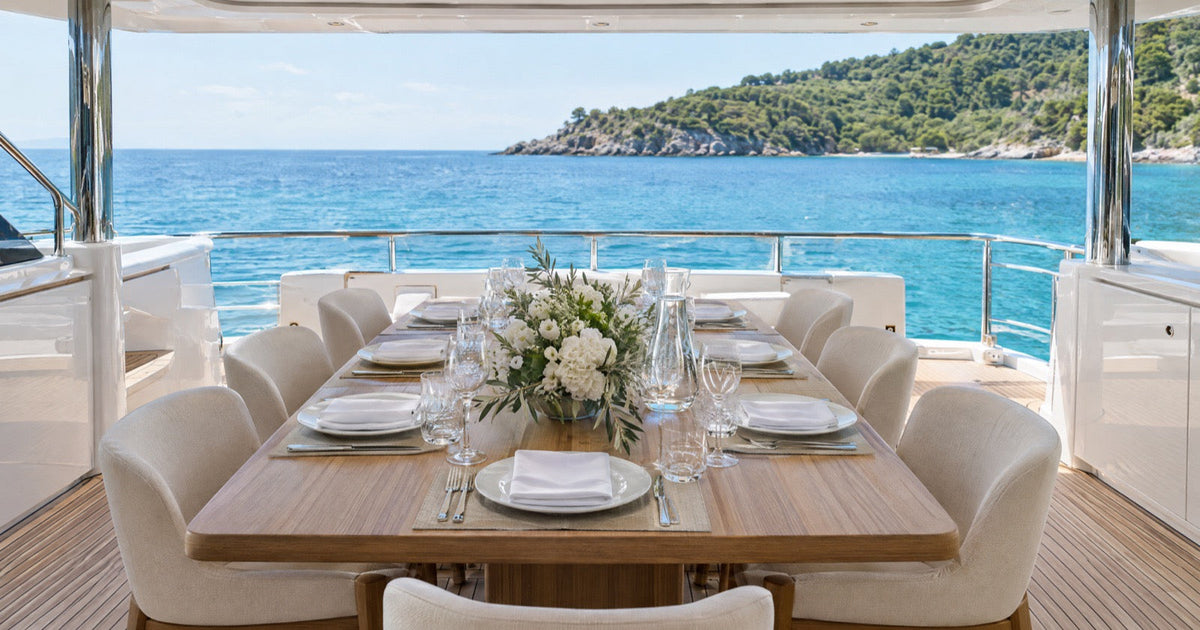 Crewed Yacht Charter Etiquette: Tipping, APA and Life Aboard
September 2026Yacht charter etiquette from the contracts: what the fee and APA cover, crew tipping after MYBA's 2026 update, crew rest, shoes, luggage ...
Crewed Yacht Charter Etiquette: Tipping, APA and Life Aboard
September 2026Yacht charter etiquette from the contracts: what the fee and APA cover, crew tipping after MYBA's 2026 update, crew rest, shoes, luggage ...