Your cart is empty
Tax included and shipping calculated at checkout
Tax included and shipping calculated at checkout

القائمة
In brief
- The short answer to "why no shoes on a yacht" is the deck. "Shoes can dent or scuff teak decks, so many yachts will have a barefoot policy," says Boat International.
- Boat International says many yachts keep shoes out of the interior and some keep them off the deck too.
- One synthetic-deck maker gives the same warning: Flexiteek's care guide rules out "marking or high heeled shoes".
- Crew usually set the basket beside the passerelle in a marina and on the tender platform at anchor, says YachtCharterFleet.
- For a small party's shoes at a covered entrance or lobby, Veyra Deck suggests the hand-woven leather towel basket from the storage collection.
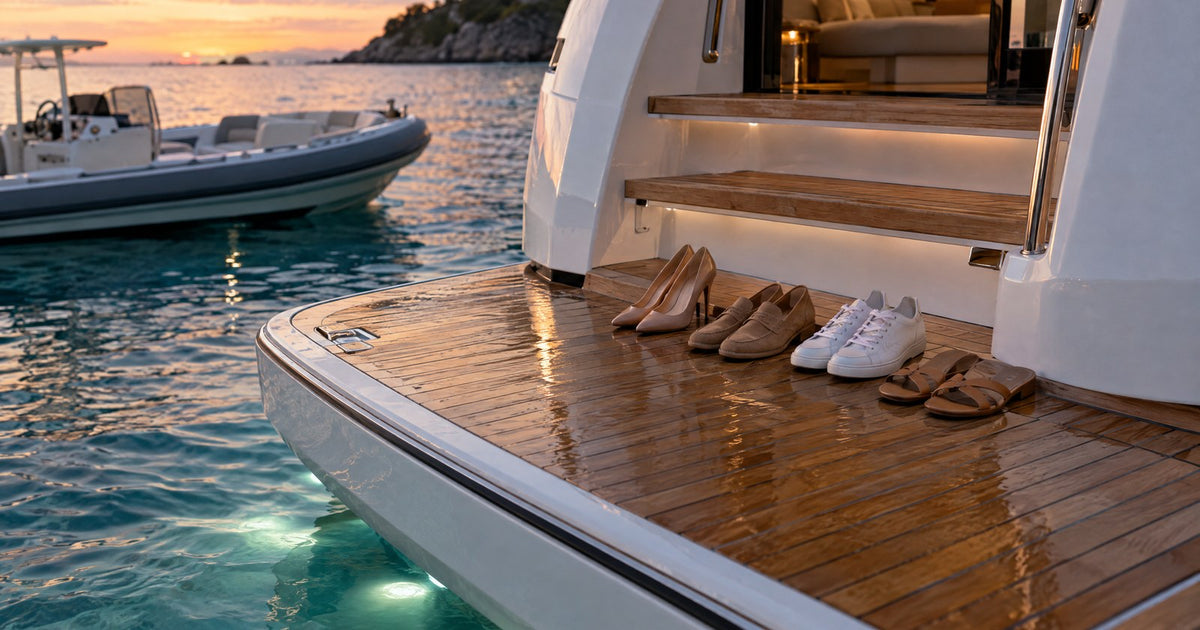
At dusk, the tender brings guests back from drinks ashore to the swim platform, which on this yacht doubles as the tender platform. The first guest steps off with her heels in her hand, and the basket is already there.
The no-shoes rule on a yacht is the house rule that guests go barefoot aboard, or at least keep their shoes out of the interior. Charter guides answer "why no shoes on a yacht" in one line: heels can dent a teak deck, and black soles can scuff it.
Shoes come off on a yacht because heels can dent teak and black soles can scuff it. Boat International, Burgess and YachtCharterFleet give that reason in near-identical words, so treat them as one consensus. A synthetic-deck maker's care guide gives the same warning, and a 1973 US government report shows how hard a stiletto heel presses on a floor.
Boat International puts it bluntly: "Stiletto heels that can dent the teak decks and black soles that leave scuffmarks are a no-no." A teak deck is not evenly hard. Practical Sailor tells owners to scrub across the grain "to avoid removal of the softer wood". Germany's Yacht magazine says that with a hard brush "the soft wood fibres are rubbed out of the surface and grooves are created".
The US National Bureau of Standards noted in 1973: "Critical loading caused by load concentration over a small bearing area is also caused by stiletto heels." Citing a 1962 study, the report gives typical stiletto-heel pressures of about 3.8 to 9.6 MPa (550 to 1,390 psi). One extreme value reached about 15.6 MPa (2,260 psi).
The MPa figures are converted from psi. The report concerns plywood floors in houses, not teak, and sets no damage threshold for any deck.
The USS Constitution Museum says modern books about the age of sail often claim that "sailors never wore shoes on board ship". The museum points to the ship's own records: 205 of the 398 men in Constitution's December 1803 slop book, slightly more than half, bought shoes that month. A slop book was the purser's record of clothing sold to the crew. No source checked for this guide traces the yacht rule to naval custom; charter guides give the deck as the reason.
Flexiteek's care guide for its 2G synthetic decking says: "Do not wear marking or high heeled shoes on your Flexiteek 2G deck." Veyra Deck's suggestion for a synthetic deck: read the maker's own care guide on footwear.
The no-shoes rule on a yacht has two tiers. On many yachts, Boat International says, shoes stay out of the cabins and interior; on others, no shoes are worn on deck either. Where shoes are allowed on deck, they should be soft-soled boat shoes, and land shoes come off again when guests step back aboard.
In YachtCharterFleet's words, "Most yachts will ask guests to abide by the 'bare feet' rule whilst on board." Boat International is more cautious: only "others" extend the rule to the deck. So the answer to "can you wear shoes on a yacht?" depends on where aboard you are, and on the yacht.
Where shoes are allowed on deck, Boat International says they "should be soft-soled 'boat shoes'". The same etiquette for shoes on a boat applies on smaller boats. Discover Boating, from the US National Marine Manufacturers Association, says boat shoes have "non-marking soles".
For trips ashore, YachtCharterFleet advises: "Land shoes are fine for venturing ashore, just remember to take them off as soon as you step back on board." It also suggests packing water shoes for water sports. On hot decks, Flexiteek advises "foot protection in very hot climates", because "most deck coverings will get hot underfoot".
Shoes on board, by place
| Where | Usual rule | Source wording (short) |
|---|---|---|
| Guest cabins and interior | Shoes off on many yachts | Shoes "stay outside the cabin" (Boat International) |
| Open deck | Bare feet on many yachts; soft-soled boat shoes where shoes are allowed | "Most yachts will ask guests to abide by the 'bare feet' rule" (YachtCharterFleet); "soft-soled 'boat shoes'" (Boat International) |
| Returning from ashore | Shoes off on stepping back aboard | "take them off as soon as you step back on board" (YachtCharterFleet) |
| Tender and water sports | Water shoes worth packing for water sports | "it may be worth packing some water shoes" (YachtCharterFleet) |
| Hot deck | The deck maker advises foot protection in very hot climates | "most deck coverings will get hot underfoot" (Flexiteek) |
Note any medical need on the preference sheet before boarding. YachtCharterFleet's preference sheet guide lists "Any medical needs the crew should be made aware of"; the sheet it describes does not mention footwear.
The shoe basket goes where guests step aboard. According to YachtCharterFleet, crew usually leave it beside the passerelle when the yacht is in a marina, and on the tender platform at anchor. Boat International puts it "at the end of the gangway or outside the salon door".

Dockwalk's guest arrival guide lists "no shoes on board" among the house rules covered at arrival. Burgess says the custom holds at boat shows too: "Even at shows, yachts will have shoe baskets for you to drop yours in."
For the passerelle and other terms used here, read the guide to rooms on a yacht.
What happens to guests' shoes after the basket varies by yacht, and the sources checked describe no standard routine. The arrival briefing, which covers the no-shoes rule, is the place to ask. The one published account found is a single chief stewardess's diary.
In that diary, on the blog My Grateful Plate (byline Tashels), shoes pass from the chief stew to the housekeeping stew. She "runs them behind the bar to brush them off, wipe them, and then starts collecting the other shoes to do the same." It is one stew's account on one yacht; the post does not say where the shoes go next.
In 2014, Yachting magazine featured a shoe basket with "open patchwork for water drainage and air circulation".
Read Dockwalk's guide for how stews run the arrival.
Sizing a shoe basket starts with the party, because no source checked says how many pairs any basket holds. Part A of the Red Ensign Group Yacht Code (MSN 1895) covers commercial yachts of 24 m and over carrying no more than 12 passengers. A full party of 12 boarding together means at least 12 pairs at once.
Smaller boats and yachts under other codes work to different rules. Where guests can board at two points, such as the passerelle and the tender platform, Veyra Deck suggests a second basket. Each basket stands beside the passerelle in a marina, or on the tender platform at anchor. The table below names no basket size.
Shoe station planning by party size (Veyra Deck's suggestion, not a standard)
| Party | Suggestion |
|---|---|
| 2–4 guests | One basket per boarding point in use |
| 5–8 guests | One basket per boarding point in use, with room for every pair boarding there |
| 9–12 guests | One basket per boarding point in use; room for one pair per guest, up to 12, if all board together |
Ask about a basket sized for a yacht project: info@veyradeck.com
No source checked compares leather, rattan and canvas for a shoe basket. Veyra Deck's view: whatever the material, keep the basket under cover, out of spray and full sun, with an open weave and somewhere to dry. Museum guidance from the Canadian Conservation Institute (CCI) shows why for leather and plant materials.
The CCI's leather guidance says long exposure to high light and UV can lead to "physical weakening and embrittlement of skins and leathers". It also warns: "Most skins and leathers are damaged if in direct contact with water." Mould can grow on leather above 65% relative humidity. The CCI's mould note says: "Generally mould will grow after two days at 90–100% RH, 10 days at 80% RH and 100 days at 70% RH." Damp leather "should be dried as quickly as possible".
For plant materials, the class that includes rattan, cane and other natural-fibre wicker, the CCI's basketry guidance says "mould can grow" above 65% RH. It adds: "Below 40% RH, plant materials become increasingly desiccated and brittle." Uneven wetting, it warns, can leave "light and dark patches as well as tide lines". Canvas is left out: the sources checked do not cover it outdoors.

For a small party's shoes at a covered entrance or lobby, Veyra Deck suggests the Hand-Woven Leather Towel Basket, 36 cm, from $600. It is sold as a towel basket for a yacht head or dressing area. Its product page gives no shoe capacity; check its 36 × 36 × 24 cm against the pairs expected.
The basket is hand-woven in Türkiye from leather strips, which are the structure: there is no frame and no lining. It comes in eight colourways: Black, Brown, Navy Blue, Beige, Grey, Tan, Mink and Khaki.
The basket's care note asks for a soft, slightly damp cloth and no chemical cleaners, alcohol or bleach, and says to avoid prolonged direct sunlight. Hence a covered entrance or lobby, not the tender platform.
See the storage collection; for care aboard, read leather care on a yacht.
A shoe station on a yacht is the basket, its place and the words that go with it. Items with a link below are sourced; the rest are Veyra Deck's advice for chief stews and yacht managers, not an industry standard.
For the basket's leather, follow the routine on the care and maintenance page.
The six answers below cover the reason for the barefoot rule on a yacht, heels, what to wear, where shoes go, the navy story and synthetic decks. Sourced claims link to their source, and Veyra Deck's own advice is marked as such.
Most charter yachts ask guests to go barefoot because shoes can mark the deck. In Boat International's words: "Shoes can dent or scuff teak decks, so many yachts will have a barefoot policy." It singles out stiletto heels and black soles, as do Burgess and YachtCharterFleet.
High heels should not be worn on board a yacht. YachtCharterFleet says "Stiletto heels should never be worn onboard a yacht", because they can damage teak decking. A 1973 National Bureau of Standards report on house floors, not teak, gives typical stiletto-heel pressures of about 3.8 to 9.6 MPa (550 to 1,390 psi). The figures show how a heel concentrates load; they set no limit for a deck.
Soft-soled boat shoes, and only where a yacht allows shoes on deck. That is Boat International's advice; YachtCharterFleet accepts "any clean pair of light rubber-soled shoes" on deck. A Discover Boating article on BoatTest adds that "a non-marking sole won't leave an ugly black streak on a boat's deck".
In the basket the crew set out at the boarding point, by the passerelle in a marina or on the tender platform at anchor, says YachtCharterFleet. Another YachtCharterFleet guide says to use the baskets "whenever you return to the yacht after a day's exploration or evening ashore". What happens next varies by yacht.
No source checked for this guide traces the yacht barefoot rule to naval custom. The USS Constitution Museum points to the ship's records: 205 of the 398 men in Constitution's December 1803 slop book bought shoes that month. That cuts against the barefoot-sailor story. Charter guides give the deck as the reason.
Yes, for at least one synthetic teak maker. Flexiteek's care guide for its 2G decking says: "Do not wear marking or high heeled shoes on your Flexiteek 2G deck." No comparable text from other deck makers turned up, so Veyra Deck's advice is to follow the yacht's own rule.
Veyra Deck's advice is to start a shoe station with one basket where guests step aboard, kept under cover if the boarding point allows. For a small party's shoes at a covered entrance or lobby, Veyra Deck suggests the Hand-Woven Leather Towel Basket, 36 cm, sold as a towel basket. See the rest of the storage collection.
For the rest of life aboard, read the crewed yacht charter etiquette guide; for the cabins, use the yacht guest cabin checklist.
Every piece is finished and packed by hand before it leaves Türkiye. Orders are dispatched within 3-7 business days and typically arrive 6-10 business days after dispatch, about 2-4 weeks in all. Shipping is free worldwide and duties are paid.
Returns are accepted within 30 days of delivery with a prepaid return label; bespoke pieces are excluded. See the refund policy.
Bespoke sizes and finishes are available for yacht and contract projects: info@veyradeck.com. For outfitting several yachts or a fleet, see wholesale.
Sources
Sources checked 18 October 2026. Sourcing follows our editorial standards.
 Round Rope Serving Tray: Which Size Carries What
November 2026Choosing a round rope serving tray: 13.8 in or 17.7 in, how many glasses fit on each, how to carry a full tray, and care for the glass an...
 How to Serve Raki (Rakı): Water, Ice and the Meze Table
November 2026How to serve raki the Turkish way: chilled water, ice if wanted, tall glasses and meze, plus the law behind raki's 40% minimum alcohol st...
 How to Chill Champagne in an Ice Bucket, Indoors and on Deck
November 2026How to chill Champagne in an ice bucket: half ice, half water, 20–40 minutes from a cool bottle to 46–50°F (8–10°C), and how to keep it c...