Your cart is empty
Tax included and shipping calculated at checkout
Tax included and shipping calculated at checkout
القائمة
In brief
- Rakı (often written raki in English) is a colorless grape and aniseed spirit of at least 40% alcohol by volume, made only in Türkiye (GI No. 136). The Turkish Food Codex 2026/18 restated the rules on 1 October 2026.
- How to serve raki: fill a tall glass a third of the way, or closer to half, then add water, ice or both (SBS Food). No source checked sets a fixed ratio.
- Water turns rakı milky white because anethole, the main aroma compound of aniseed, comes out of solution as droplets that scatter light: the ouzo effect.
- If ice goes in, it goes in after the water. Difford's Guide gives that order for arak, and the same chemistry applies to rakı.
- For the table, Veyra Deck suggests the Rope Raki Serving Tray with 6 Glasses, from $320, which carries the bottle and six glasses together. See it with the other rope trays.
A gulet lies at anchor in a bay on the Turkish coast, and the horizon is starting to redden. Aykut Şimşek's 2021 academic paper on the rakı table gives the time when the horizon begins to redden as the generally accepted hour to begin (our translation). How to serve raki at that hour comes down to chilled water, a decision about ice, tall glasses and meze (small shared plates).
Rakı is a colorless distilled spirit of at least 40% alcohol by volume, made only in Türkiye by distilling suma, a grape spirit, with aniseed. The rules come from GI No. 136, Türkiye's registered designation of origin, and from the Turkish Food Codex 2026/18, published on 1 October 2026.
Rakı is a protected Turkish designation of origin, registered as GI No. 136 under the name "Rakı". The law sets where rakı is made, what goes into the still, how strong it must be and how long it rests. A new Turkish food codex, published in the Official Gazette on 1 October 2026, restated those rules.
TÜRKPATENT, Türkiye's patent office, dates the registration to 18 June 2010, effective from 15 April 2009, with an amendment of 15 December 2022. In the table, "GI" is that patent office file and "Codex" is Annex 1 of Codex 2026/18; the translations are Veyra Deck's own.
What the law requires of rakı
| Requirement | Rule | Source |
|---|---|---|
| Where it is made | Only in Türkiye, with every production step inside the country | GI; Codex |
| Base | Suma from grapes grown in Türkiye (fresh grapes, raisins or both), alone or blended with agricultural ethyl alcohol; suma is at least 65% of the alcohol put into the still | GI; Codex |
| Stills | Traditional copper stills of about 1,320 US gallons (5,000 liters) or less | GI; Codex |
| Aniseed | Pimpinella anisum, grown in Türkiye | Codex |
| Anethole | At least 800 mg per liter | GI; Codex |
| Strength | At least 40% alcohol by volume | GI; Codex |
| Additives | No flavorings, sweeteners, colorings or other additives | GI |
| Rest | At least one month before bottling | GI; Codex |
| Fresh-grape rakı | Only suma, and only suma made from fresh grapes | GI |
The milky glass is old. The patent office file states that Gautier, in Istanbul in 1852, wrote that rakı turned white and was drunk from large glasses (our translation). The same file dates the state monopoly to Law No. 4250 of 12 June 1942, which gave Tekel control of spirits production. Wikipedia gives 1944, in İzmir, as the year of Tekel's first factory production of rakı. Both sources date Tekel's privatization to 2004, which the patent office file states ended the state monopoly.
Rakı turns white when water is added because of the ouzo effect. Anethole, the main aroma compound of aniseed, dissolves well in alcohol but barely in water. Diluting the spirit pushes it out as tiny droplets that scatter light, so the clear drink turns milky in the glass.
Wikipedia defines the effect as the formation of "a milky oil-in-water emulsion when water is added to ouzo and other anise-flavored liqueurs". The peer-reviewed reference is a 2003 paper in Langmuir by Steven A. Vitale and Joseph L. Katz (Crossref record). Its title is Liquid Droplet Dispersions Formed by Homogeneous Liquid−Liquid Nucleation: 'The Ouzo Effect'.
Turkish law ties that chemistry to the glass. Türkiye's patent office registry requires at least 800 mg of trans-anethole per liter of rakı. It states that less would delay the whitening when water is added, so the drinking strength would fall too far (our translation).
The white color gave rakı its nickname. Wikipedia records that the drink is popularly called aslan sütü (lion's milk). Şimşek's paper states that the whiteness suggested milk, and the lion came from the idea that only the brave-hearted could drink it (our translation).
Serving rakı the Turkish way starts with a cold bottle and chilled water. Rakı goes a third of the way up a tall glass, or closer to half, and chilled water turns it white. Ice, if used, goes in after the water, as Difford's Guide advises for arak. Some drinkers take it straight, with water on the side.
Şimşek's paper states that rakı connoisseurs do not consider ice proper (our translation). In its small study of 17 drinkers in Sivas, 64% mixed their rakı with water and 13% added ice.
Three ways to pour rakı
| Style | How | Source |
|---|---|---|
| Mixed with chilled water | Rakı a third of the way up a tall glass, or closer to half, topped up with chilled water | SBS Food; Wikipedia |
| Mixed, ice added after the water | As above, with ice added once the water is in | Difford's Guide (stated for arak); EU ouzo file (chemistry) |
| Straight, with water on the side | Rakı alone in the glass and a glass of water beside it, each sip followed by cool water | SBS Food; Hürriyet Daily News |
The diagram sets the three pours side by side.

NIAAA puts one US standard drink at about 0.6 fl oz (14 g) of pure alcohol. By arithmetic, a 2 fl oz (60 ml) pour at 45% is about 1.5 standard drinks, and adding water does not change that. The 45% sits mid-way in the 40 to 50% range SBS Food gives.
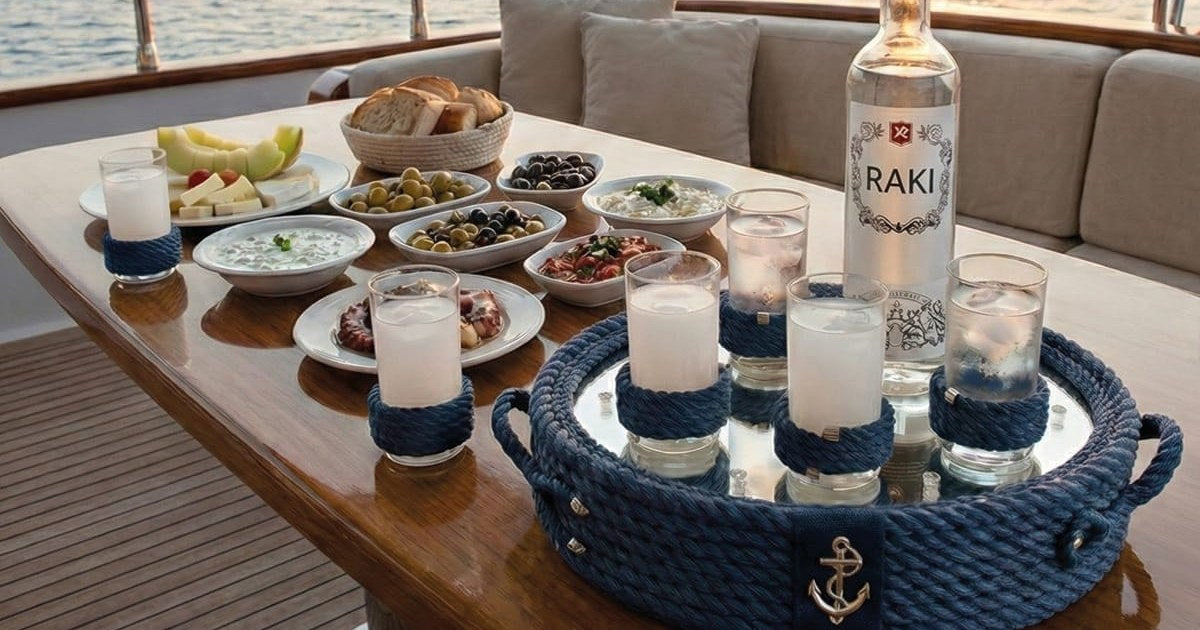
The Rope Raki Serving Tray with 6 Glasses, from $320, carries the bottle and six glasses to the table together. Each clear glass sits in a rope sleeve around a place for the bottle at the center. Its oval rim is marine rope wound by hand in Türkiye, with loop handles and a metal anchor emblem. It measures 15 × 12.2 × 5.5 in (38 × 31 × 14 cm), comes in five rope colors and is sold without the bottle.
For the water, the Rope-Wrapped Glass Carafe with Rope Base, from $240, stands 11 in (28 cm) tall on a coiled rope base. The Rope Ice Bucket with Tongs and Lid, from $270, measures 5.9 in (15 cm) across and high. Its tongs clip to the side, so guests serve their own ice.
See the rope trays.
Rakı is drunk with meze, and the table has an order. White cheese and melon come first, then more meze; in a meyhane (tavern), the mains are mostly seafood. Rakı is not drunk without food, and the table runs long: in one small study, 41% of participants spent about four hours.
Öney Tan calls rakı with kavun (melon) and beyaz peynir (white cheese) "The unwritten holy trinity of Istanbul nights". She also writes that "Rakı is never drunk without food".
The MICHELIN Guide Türkiye states that a meyhane meal starts with very good white cheese, joined by a slice of melon in season (our translation). In Şimşek's small study, white cheese was the meze almost all 17 participants preferred.
The toast is Şerefe (cheers); GoTürkiye notes that the word also means in your honor. Wikipedia records that "the bottoms of rakı glasses should be used to toast rather than the rims, as a way of showing mutual respect". SBS Food gives the same advice.
Two Rope Raki Glass Holders in Navy Blue hold tall glasses of rakı at a deck table at sunset.

The Rope Raki Glass Holder with Metal Rim, from $80, holds one tall rakı glass in a copper-tone cup. Its body is marine rope wound by hand, with a wide silver-tone metal rim. It measures 4.7 in across and 3.9 in high (12 × 10 cm) and is sold as one holder, without the glass. Its original name, Ehl-i keyf, is Turkish for someone who knows how to enjoy the rakı table.
For olives or nuts, the Rope Snack Bowl with Glass Insert, from $90, is 5.5 in across and 3.1 in high (14 × 8 cm). It comes with a glass inner bowl. The Small Glass Serving Dish with Rope Holder, from $180, takes a single meze. It measures 11 × 8.3 × 3.5 in (28 × 21 × 9 cm), and the glass dish lifts out.
For the plates, cutlery and glasses around them, read how to set a table on a yacht.
Rakı and ouzo are close relatives in the anise family. A 2010 review in Food Reviews International judges them more alike than the others, "just like brothers from the two shores of the Aegean Sea". Arak, pastis and sambuca are anise-flavored too, but differ in origin, strength and the usual pour.
The anise family compared
| Drink | Where | Legal minimum or typical strength | Usually served | Source |
|---|---|---|---|---|
| Rakı | Türkiye | At least 40% ABV (legal minimum) | With chilled water on the side or partly mixed | GI No. 136; Codex 2026/18; Wikipedia |
| Ouzo | Greece and Cyprus | At least 37.5% ABV (legal minimum) | With water; "nowadays adding ice is more common" | EU ouzo technical file |
| Arak | The Levant | Typically 53% ABV (not a legal figure) | About 1 part arak to 2 parts water, poured into ice-filled cups | Wikipedia |
| Pastis | France | At least 40% ABV; pastis de Marseille at least 45% (legal minimums) | About 5 parts water to 1 part pastis, or neat with a jug of water | EU Regulation 2019/787; Wikipedia |
| Sambuca | Italy | At least 38% ABV (legal minimum in Türkiye's codex) | Neat, on the rocks or with water | Codex 2026/18; Wikipedia |
In 2018 the US federal alcohol regulator, the TTB, moved ouzo out of liqueurs and listed it as an "anise flavored distilled spirits product".
Serving rakı on a yacht deck follows the steps above: chilled water, any ice after the water, and food on the table. No source checked describes rakı on a modern yacht, so the deck practice below is Veyra Deck's suggestion. The gulet itself has a longer history with rakı.
After his exile to Bodrum in 1925, the writer Cevat Şakir began taking friends out on sponge divers' boats called gulets, the start of the Blue Voyage.
An essay in Guernica on his voyages records the supplies: "For provisions they had cheese, crackers, tobacco, and rakı." Şimşek's paper gives the hour in Turkish as "ufkun yavaş yavaş kızarmaya başladığı zamandır", the time when the horizon slowly begins to redden (our translation).
For serving on deck, Veyra Deck suggests chilled water in a carafe and ice in a lidded bucket with tongs. Veyra Deck also suggests carrying the bottle and all six glasses up on one tray, and setting the tray down on the table before anyone pours. Keep the bottle and the carafe in shade until the first pour. The Rope Ice Bucket with Tongs and Lid comes with its lid and tongs, and the Rope Raki Serving Tray with 6 Glasses has loop handles for carrying.
See the rope bar collection.
A checklist for serving rakı runs from the cold bottle to the toast and the food. Items that name a source are sourced; the rest are Veyra Deck's advice for hosts and crew, not a published standard. Work through it before guests sit down, at home or at anchor.
To carry the bottle and glasses as one, see the Rope Raki Serving Tray with 6 Glasses.
Common questions about rakı cover its ingredients, its strength, its link to ouzo, why it turns white, whether it takes ice and what to eat with it. Each answer stands alone, links to its source and marks where Veyra Deck's own advice appears.
Rakı is made from suma, a grape spirit, distilled a second time with aniseed in copper stills (Anli and Bayram). The grapes are grown in Türkiye and may be fresh, dried as raisins or both. Under GI No. 136 and the Turkish Food Codex 2026/18, at least 65% of the alcohol in the still must be suma. The GI also bars flavorings, sweeteners and colorings.
No. Rakı and ouzo are separate drinks under separate laws. Rakı is made only in Türkiye, at a legal minimum of 40% alcohol by volume (GI No. 136). Ouzo is made only in Greece and Cyprus, at a legal minimum of 37.5% (EU technical file). The same file says ice is now more common with ouzo.
Rakı must be at least 40% alcohol by volume under GI No. 136 and the Turkish Food Codex 2026/18. SBS Food puts its strength at 40 to 50%. By arithmetic, 40% is about 3.3 times the strength of the 12% wine NIAAA uses in its standard-drink examples. Adding water lowers the strength in the glass but not the amount of alcohol.
Rakı turns white through the ouzo effect. Anethole, the main aroma compound of aniseed, dissolves well in alcohol but barely in water (Wikipedia). Added water forces it out as droplets about a micron across, which scatter light (Wikipedia). Türkiye's patent office registry requires at least 800 mg of anethole per liter and states that less would delay the whitening (our translation).
Some drinkers add ice, though a Turkish academic paper states that rakı connoisseurs do not consider it proper (our translation). In the paper's small study of 17 drinkers, 64% mixed rakı with water and 13% added ice. If ice goes in, add it after the water. Difford's Guide gives that order for arak, and Veyra Deck suggests the same for rakı.
White cheese and melon come first (MICHELIN Guide Türkiye, our translation). GoTürkiye, Türkiye's official tourism portal, says rakı is typically served with melon and white cheese. MICHELIN also states that the mains in a meyhane, or tavern, are mostly seafood (our translation). A Hürriyet Daily News columnist writes that "Rakı is never drunk without food".
Veyra Deck's advice is to start with the Rope Raki Serving Tray with 6 Glasses, which brings the bottle and six glasses to the table together. Add a rope-wrapped carafe for the chilled water, and a glass holder for a single tall glass at a place setting.
See the rope trays and the wider Rope Collection. Wipe the rope with a damp cloth; the rope pieces are not dishwasher safe. The care and maintenance page sets out the full routine.
Every piece is finished and packed by hand before it leaves Türkiye. Orders are dispatched within 3-7 business days and typically arrive 6-10 business days after dispatch, about 2-4 weeks in all. Shipping is free worldwide and duties are paid.
Orders ship Delivered Duty Paid (DDP): we pay customs duties and import taxes, so the checkout price is the total. Nothing is charged on delivery.
Returns are accepted within 30 days of delivery with a prepaid return label; bespoke pieces are excluded. See the refund policy.
Bespoke sizes and finishes are available for yacht and contract projects: info@veyradeck.com. For outfitting several yachts or a fleet, see wholesale.
Sources
Sources checked 1 November 2026. Sourcing follows our editorial standards.
 Round Rope Serving Tray: Which Size Carries What
November 2026Choosing a round rope serving tray: 13.8 in or 17.7 in, how many glasses fit on each, how to carry a full tray, and care for the glass an...
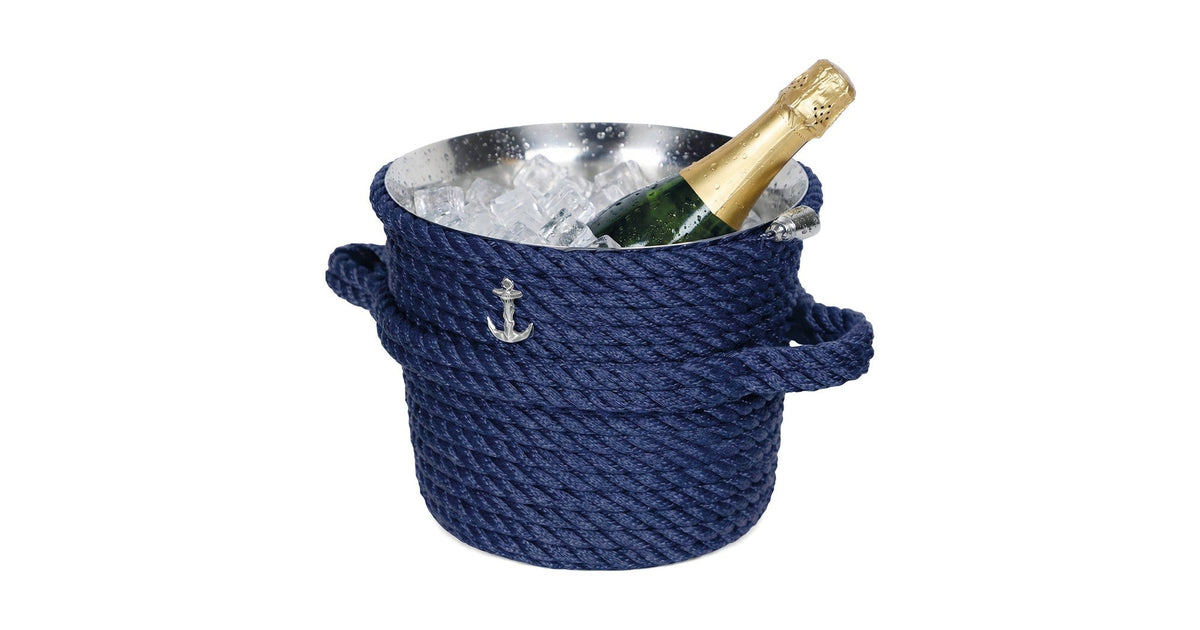 How to Chill Champagne in an Ice Bucket, Indoors and on Deck
November 2026How to chill Champagne in an ice bucket: half ice, half water, 20–40 minutes from a cool bottle to 46–50°F (8–10°C), and how to keep it c...
 How to Set a Table on a Yacht: Service Styles Compared
October 2026How to set a table on a yacht: the cover, service styles from silver service to family style, and what to change when the deck moves or t...